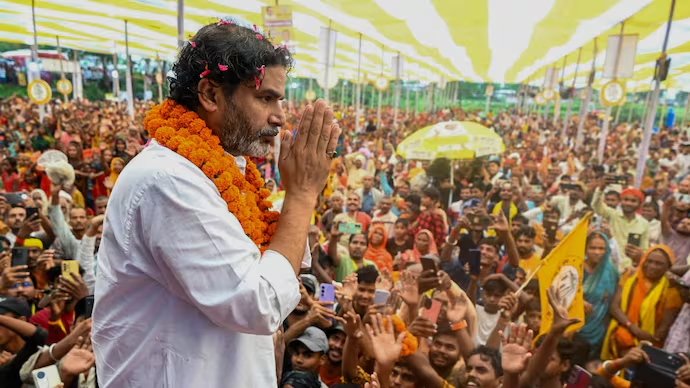
Prashant Kishor’s political experiment in Bihar has become one of the most revealing case studies in the functioning of Indian democracy. Despite raising issues that cut to the very heart of Bihar’s socio economic distress, including the chronic collapse of public education, the mass migration of labour, the stagnation of employment, the deep rooted corruption in governance and the persistent failures of the health system, his newly formed party could not translate this agenda into even a single seat in the Assembly. This result raises questions that go far beyond one election or one leader. It forces us to examine the complex relationship between democratic aspirations, voter behaviour and the structures of power that shape electoral outcomes in India.
Kishor attempted something rare in Indian politics. He tried to make developmental issues the central axis of political mobilisation. His campaign was built on a simple promise that citizens deserve dignity through functional public services, human capital investment and an administration that is accountable to them. He walked through districts, listened to people with patience, and spoke constantly about the long term structural challenges Bihar faces. In many ways, his agenda was not a political stunt but a governance vision. Yet, even with this clarity of purpose, he could not convert public frustration into votes.
This disconnect reveals the resilience of older political identities in Bihar. Caste networks, long standing patronage systems, legacy loyalties and local power dynamics continue to outweigh issue based politics. For many voters, the immediate social security provided by entrenched networks still feels more tangible than promises of institutional reform, however sincere those promises may be. Kishor’s defeat therefore becomes a lens through which we can see the limits of developmental rhetoric in a society where political identity is still shaped by decades of historical marginalisation and social hierarchies. It shows that information and rational arguments alone cannot overturn the emotional and structural foundations of voting patterns in states like Bihar.
His loss also highlights something crucial about Indian democracy. Electoral success is not always a reflection of who brings the best ideas or who sincerely articulates the needs of the people. It is often a reflection of the strength of political infrastructure, the depth of social networks and the ability to convert perception into trust. Kishor entered this arena without the long entrenched machinery that traditional parties possess. In a democracy of India’s scale, where elections involve crores of people, trust is not built in a few months or even a few years. It requires generations of political presence. This reality does not diminish the value of the issues he raised, but it explains why they did not translate into political power.
At a deeper level, the outcome suggests a gap between democratic ideals and democratic practice. Citizens often express frustration with governance failures, yet when standing in the polling booth they return to the familiar. This tension shows that democracy is not only about awareness but also about psychological security. Many voters choose continuity over change because continuity offers predictability in an uncertain world. Electoral behaviour is rarely purely rational. It is embedded in fears, hopes and inherited identities.
Yet, the significance of Kishor’s attempt should not be measured only by seats. He succeeded in placing uncomfortable truths at the centre of Bihar’s public debate. He forced traditional parties to face questions they have avoided for decades. He shifted the discourse from slogans to governance. Even if he did not win, the issues he raised will shape Bihar’s political conversation for years to come. Sometimes democracy changes not when a new party wins, but when old parties are compelled to confront new expectations.
For Indian democracy, Kishor’s experiment is a reminder that electoral setbacks should not discourage attempts at reform. Democracy thrives when new voices challenge stagnation. Even failure can serve as a catalyst for transformation. His journey also reflects the hard truth that democracies need both political entrepreneurship and long term institutional engagement. Ideas alone cannot shift power, but power without ideas cannot build a progressive future.
Perhaps the most important lesson is that democracies evolve slowly. Kishor tried to accelerate this evolution by injecting governance centric politics into a deeply layered social landscape. The immediate outcome was disappointing for his supporters, but history often rewards those who persist. Indian democracy has room for voices like his, but it also demands patience, resilience and long term investment.
In the end, Prashant Kishor’s defeat is not just a political story. It is a mirror held up to a democracy that is still negotiating its identity. It reflects both the promise and the paradox of the world’s largest democracy. It shows the tension between aspiration and tradition, between reform and continuity, between what citizens say they want and what they ultimately vote for. And it reminds us that meaningful democratic change rarely arrives in one election. It comes slowly, through sustained engagement, through persistence, and through leaders who keep challenging the system even when the system does not reward them immediately.


Leave a Reply to Kuldeep Cancel reply